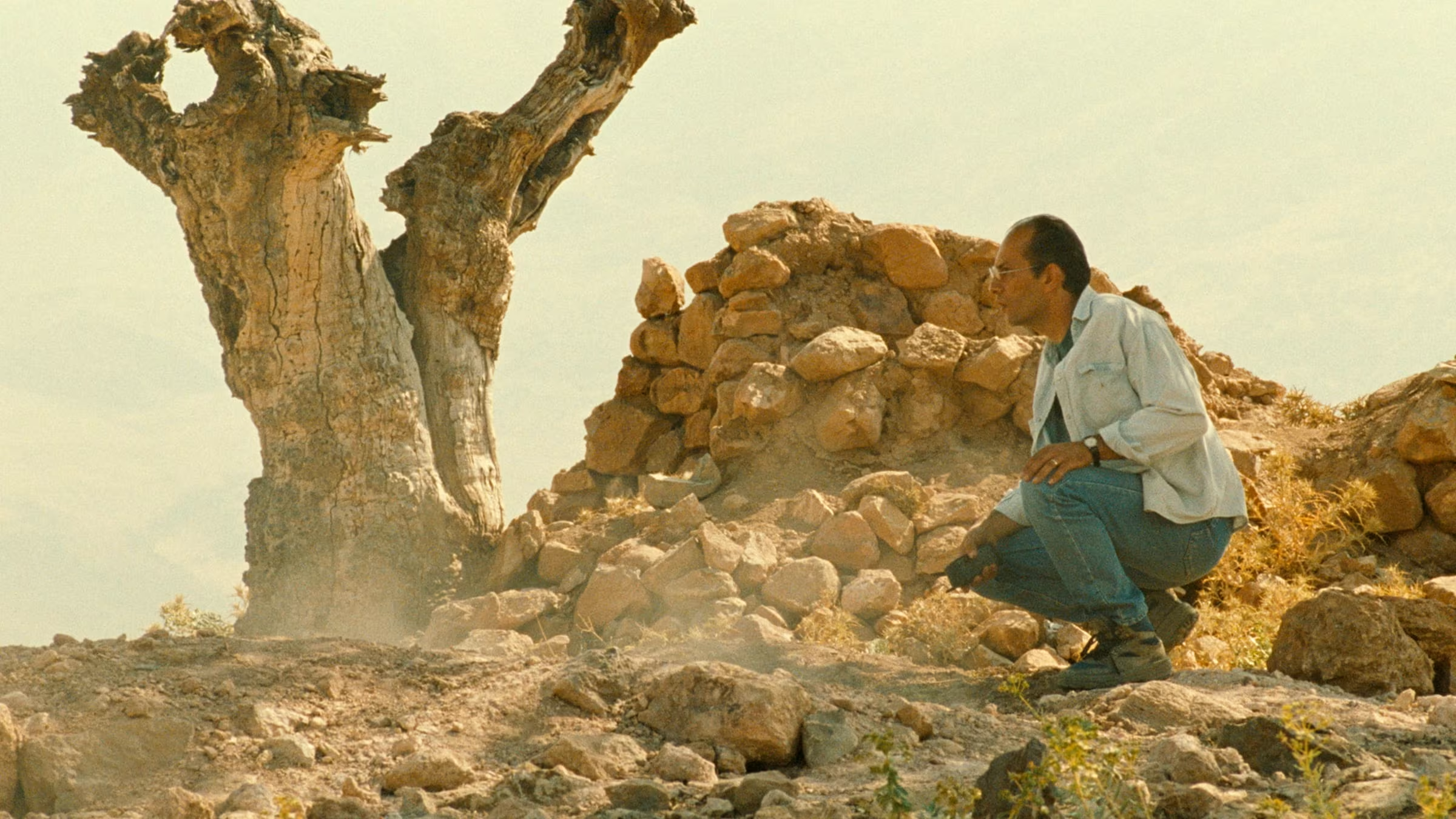
In many movies, the outdoors is a postcard: it sets the location, looks pretty, and stays politely behind the actors. In Abbas Kiarostami’s cinema, the opposite happens. The earth pushes forward. The roads insist on being followed. The hills seem to wait, like witnesses. You don’t just see nature, you negotiate with it.
That is the key to understanding Abbas Kiarostami’s landscape work: he treats space the way other directors treat dialogue. Landscape isn’t decoration. It’s a living force that shapes choices, delays answers, and quietly judges nothing at all.
So why does it feel so alive?
Because Kiarostami builds meaning out of distance, time, and the viewer’s participation, he lets the land hold the result.
Landscape isn’t a setting, it’s storytelling (without the story)
Kiarostami repeatedly challenged the idea that cinema must “explain” itself through plot. He leaned toward observation, toward an image that can stay open and still feel complete. One of his clearest statements connects directly to the way nature functions in his films: “I want my films to become closer to my photography and more distant from storytelling.”
Photography, at its best, doesn’t force an interpretation. It offers a frame and invites your mind to do the rest. That’s exactly what Kiarostami does with hills, valleys, and empty stretches of road. He doesn’t use landscape to illustrate a message. He uses it to create conditions where meaning can slowly, personally, and sometimes uncomfortably.
This is why Abbas Kiarostami’s landscape compositions can feel like characters: they “act” by withholding, surrounding, dwarfing, and delaying.
Example 1: Taste of Cherry turns the road into a moral arena
Taste of Cherry (1997), written and directed by Abbas Kiarostami.
In Taste of Cherry, Mr. Badii drives the hilly outskirts of Tehran searching for someone willing to perform a grim task after his planned suicide. The premise is stark, but the emotional engine is the landscape: dusty ridges, winding roads, and long intervals where the world simply continues.
Kiarostami’s choice to keep the car moving through barren terrain does two things at once:
- It externalizes inner emptiness without melodrama.
The hills don’t “symbolize” despair in a neat, literary way. Instead, their repetitive, indifferent presence creates a mood where despair can exist without being announced. - It makes the viewer a participant.
Extended shots and open space deny easy emotional cues. You’re not pushed toward tears or outrage. You’re given time, sometimes a lot of it, to decide what you think you’re watching.
Even the film’s basic setup is inseparable from place: Badii is driving around the hilly outskirts looking for someone to agree to bury him, and those slopes become the physical logic of the story.

This is Abbas Kiarostami’s landscape at its most radical: the land doesn’t heighten drama. It makes drama feel smaller, more human, less theatrical.
Why the wide shot feels ethical in Kiarostami
Kiarostami often places people low in the frame, swallowed by sky or hillside. That aesthetic choice carries a moral one: it refuses to “own” the character’s feelings.
A great capsule of this approach appears in a review of The Wind Will Carry Us: “What is not shown is often as crucial as what is.”
When you think about it, landscape is the perfect tool for that philosophy. Open space creates room for what’s missing: motives unstated, thoughts unshared, conclusions postponed. Instead of closing interpretation down, Kiarostami widens it, literally.
This is also why his films can feel calm while dealing with enormous topics (death, faith, responsibility). The land holds the weight, so the characters don’t have to perform it.
Example 2: The Wind Will Carry Us uses hills to measure time and humility
The Wind Will Carry Us (1999), directed by Abbas Kiarostami, written by Abbas Kiarostami.
Here, Kiarostami moves from the outskirts of a city to a rural Kurdish village. The story circles waiting, observing, and the tension between outsider curiosity and local life. Once again, the landscape isn’t just a place where events occur; it is the film’s governing rhythm.
The rural setting is not incidental; it’s essential to the film’s ethical pressure. Criterion’s essay notes how the film explores tensions between modernity and provincial life, and between artists and their subjects, tensions that become sharper precisely because the village feels rooted in its environment.
The hills do something subtle but persistent: they remind the visitor (and the viewer) that the world does not reorganize itself around your schedule, your intentions, or your story. Nature introduces a scale that human urgency can’t defeat.
That’s another hallmark of Abbas Kiarostami’s landscape: it keeps pulling you out of the ego’s close-up.
The road: Kiarostami’s recurring “moving landscape.”
If Kiarostami has a signature image, it may be a vehicle moving through rough terrain while conversation unfolds in real time. This isn’t just a stylistic habit. It’s a structural one.
The road lets him combine three elements he loves:
- Real duration (time you can feel)
- Everyday speech (conversation that wanders, pauses, restarts)
- A changing frame (landscape that evolves without “plot twists”)
In other words, movement replaces incident. The world changes because the car advances, not because the screenplay demands a turning point. That’s why the land feels alive: it keeps “speaking” through variation, light, dust, elevation, distance, even when people fall silent.
Abbas Kiarostami’s landscape is often a road landscape, a cinema where travel becomes thought.
Why was landscape also a practical form of freedom
Kiarostami worked within constraints that shaped Iranian filmmaking for decades. One reason landscape becomes so central is that it offers a kind of openness, conceptual and sometimes political. Wide space can hold ambiguity. A hillside can suggest isolation, labor, tradition, and modern intrusion without any single line of dialogue becoming a “statement.”
Because nature doesn’t argue, it can’t be easily reduced to a slogan. It simply remains, inviting you to read, and re-read.
Scholars have even framed Kiarostami’s landscapes as central to how his films produce value and meaning, treating villages and terrain as more than background architecture.
The land doesn’t just surround the characters; it completes them
Kiarostami’s genius wasn’t that he filmed beautiful hills (though he did). It’s that he trusted the landscape to do what most films assign to plot: carry uncertainty, create tension, and leave room for the viewer to finish the thought.
In Abbas Kiarostami’s landscape cinema, nature becomes a living character because it behaves like one:
- It has presence.
- It shapes decisions.
- It sets the pace.
- It refuses to “explain itself.”
And maybe that’s the deepest reason it feels alive: it doesn’t exist to serve the story. The story exists inside it.